Showing posts with label Tobias Rehberger. Show all posts

9/26/12

Ties that bind

by Seth Oliver


“Your problem is to bridge the gap which exists between where you are now and the goal you intend to reach.” – Earl Nightingale. The point of a bridge is to get from one point to another. Plain and simple. But the best bridges are those that make the journey a destination as well. A mental stimulus is what can set these structures apart. The majority of people just cross a path without noticing much of anything. This is partly due to them being wrapped up in their own lives, but also due to the unchanging footpath patterns they tread on. Giving people something to experience is a goal that more architects should try to reach. Bridges are the perfect examples. My two favorite pieces we have studied thus far have been the Pedestrian Bridge by Tobias Rehberger and Schlaich Bergermann & Partner in Oberhausen, Germany, and the Moses Bridge Ro&ad Architecten in the Netherlands.
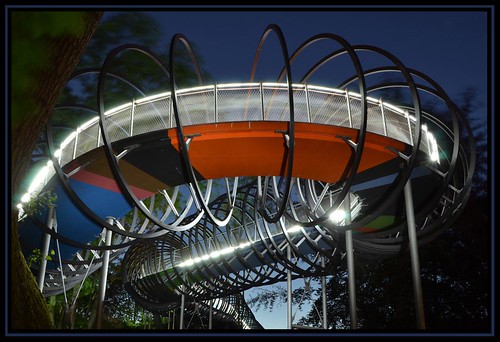
                The Pedestrian Bridge in Germany has been lovingly called the “Slinky Bridge.” The coils and colors that make up the structure are reminiscent of the toy that we all used to play with when we were younger.  Seeing this is a point of nostalgia for the older crowds traipsing across the bridge, but the massive scale of these coils are enough to grab the younger generation too. It almost seems to be a huge play-scape rather than just a bridge. To reinforce the idea of the playground above water, the artist behind the design also included specific colors on the path. The colors change depending on where you are at the moment. On a curve that is inclining, the colors are closer together in ribbons, much like a barcode. The path across the river is fairly smooth, so the color changes are more gradual. To top it all off, the spiraling metal that goes around the footpath lights up at night. This makes it a spectacle no matter what time of day and gives a playful illusion to the city. I think that more bridges should be designed in a fun way. It would make people want to cross the bridge or just stop to stare at it. We are all children in our hearts after all, so why not use that to draw people in? I would love to see my home town do something similar to this.


                The other bridge that exceeds expectations in experience is the Moses Bridge in the Netherlands. It is almost part of the landscape. I cut, or ravine if you will, shoots through the hill and divides the water. The edge conditions are especially noteworthy, in that they stop just at the point of the water on the sides to be brought up to the average person’s waist. The feeling of being in the water is one that most bridges try to avoid. This unique structure makes the walls come towards the pedristian so the the water looks as if it could flow into the path at any second. Something as simple as a bridge to hold out the water rather than going over it is a stroke of genius. This is not a sight such as the Slinky Bridge, but more of a hidden treasure for the adventurer. The mental stimulus from this masterpiece is very much worth the trip. Calmness abounds in the still water, and people can glide through it without disturbing scene.


Bridges are some of my favorite structures to study. The importance of the connections can always be highlighted in a way to enhance the experience. I cannot wait to see what other designs can be built in the future. 

9/14/12

Appeal of the Surreal

Appeal of the Surreal

By Sarah Wilson

A study of how surrealism works on the mind

“It is an irrational architecture which does not fall in with any ideas of comfort; it is figurative, even metaphorical. Its aim is to make habitable monumental pieces of sculpture, preferably representing creatures or objects.” (Sarane Alexandria 1985)

                We are attracted to odd things; it’s in our human nature to be curious. Architects like Le Corbusier, Tobias Rehberger, and Liz Diller & Ricardo Scofidio took advantage of this fact when creating some of their works, whether they were purposely creating under the label of ‘surrealism’ or not. Creations like Le Corbusier’s Beistegui Apartment,  Rehberger’s “Slinky Springs to Fame” pedestrian bridge, and Diller & Ricardo’s “blur” pavilion each have elements of surrealism that attract our eye, and those elements are successful for particular reasons.
Beistegui roof garden
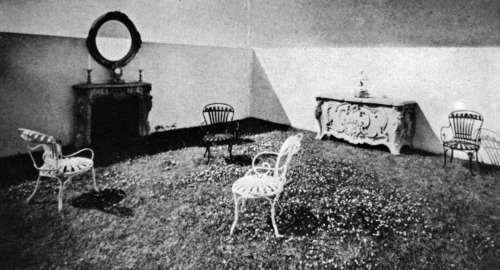
                A glimpse at the roof garden in the Beistegui Apartment may summon an image from Alice in Wonderland. The seemingly ordinary living room, complete with seating, bureau, fireplace, and mirror, suddenly seems extraordinary when on realizes the material of the ‘carpet’. This irrational placement of typical indoor furniture in an outdoor setting is what suggests this garden to be a work of surrealism. Perhaps stranger still is the high, solid walls juxtaposed with not a hard ceiling, but a soft sky. The appeal of the Beistegui roof garden is the existence of these unexpected juxtapositions, which attract attention and render the design successful.
"Slink Springs to Fame"
              
          Rehberger’s pedestrian bridge has an unexpected appearance as well. With a name like “Slinky Springs to Fame”, there’s little question where Rehberger got his inspiration. Pedestrians will likely be surprised upon their first encounter with this bridge, with or without the knowledge of its name. This elevated bridge twists and winds around a forest of trees, ringed with endless slinky-like loops and striped with bright colors. Said colors respond to the curve of each bend in the bridge and glow in the nighttime setting. The surrealism comes with the super-enlargement of the well-known toy, transforming its previous playtime purpose to one of function. The success of this piece is the direct representation of a beloved childhood artifact, combined with the purpose of connecting two points with a path. Far from being straightforward, the bridge captures the character of the slinky and dances around the forest from start to finish. Thus, the appeal of Rehberger’s work is more so the experience than the end result, much like the slinky—watching it flop down the stairs is far more exciting than seeing it come to a plopping stop at the bottom.
'blur' pavillion
                It wasn’t a large, low-lying cloud floating over Switzerland’s Lake Neuchatel in 2002. This ever-changing cloud of mist was the work of Diller & Scofidio, a temporary pavilion for the Swiss Expo. Constructed over the lake with steel and 13,000 water jets, the ‘blur’ pavilion was a habitable sculpture created from an infinite number of water droplets. Within this cloud was the Glass Box, a small field of green contained within glass walls and roof to make visitors feel suspended in that fog. This habitable sculpture element lends itself to surrealism, as well as the strange physical experience. It must have seemed unreal to stand within a cloud, suspended over the surface of the lake, but there is an appeal to this experience in its uniqueness. There a few chances for humans to stand within clouds, and the ‘blur’ pavilion provided this surreal experience, and so it was successful.
                We can’t often help ourselves when presented with something strange. If an object, place, or experience seems new or alien, our curiosity often overwhelms rational thought. The irrational, metaphorical, and unexpected qualities of surrealism make it appealing to many. This partially explains the success of the Beistegui apartment roof garden, the “Slinky Springs to Fame” bridge, and the ‘blur’ pavilion—each offered an experience that was strange but imaginative, and they attracted attention. Whether their architects meant for these pieces to be surreal or not, the elements are there, and they work.
               
Works cited:
Sarane Alexandria, . Surrealist Art. Thames & Hudson, 1985.