Showing posts with label Albert Speer. Show all posts

9/4/12

Speer vs. Scharoun


By Fielding Lowrance

Berlin has had a rather volatile political history. Both World Wars and the Cold War have had a pronounced effect on the city. Because of these events Berlin has become a great example of how the social and political climate of an area can influence the designs of the architects working in that region at any given time. Two architects who illustrate this idea particularly well are Albert Speer, who designed buildings for the Nazi Regime, and Hans Scharoun, whose buildings were created under the democratic German government established after the second World War.
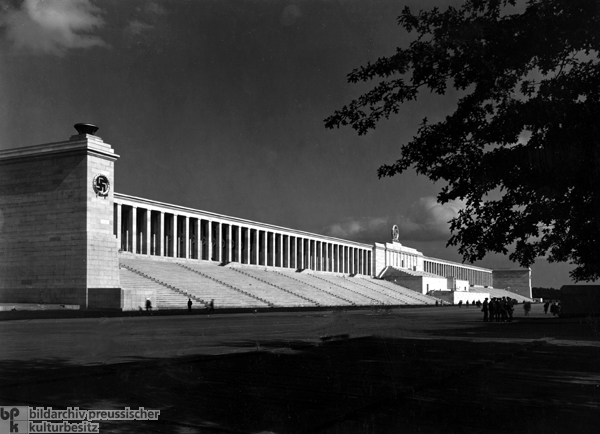
Albert Speer - Zeppelin Field


Albert Speer’s close affiliation with the Nazi party resulted in the creation of works that reflection the greatness of the state.  Speer’s buildings were grand neoclassical structures that often included features such as arches and domes. The strictly regimented forms of neoclassical architecture mirrored the rigid and authoritarian nature of the Nazi Party. Additionally, neoclassicism relies of forms, proportions, and materials that had been previously established by classical architects (i.e. the architects of Ancient Greece and Rome). This reference of the Classical served a dual purpose. First, using building elements that the public would have already been familiar with created a sense of non-transience and a climate in which deviance from what the government defined as acceptable was unacceptable. Second the reference to the civilizations of Greece and Rome created a connection between the Nazi Regime and great Civilization of the past. This both helped to further the idea of the permanence of the current government institution and mirrored the way in which the aforementioned civilizations (particularly the Roman Empire) used buildings and monuments to attest to their strength, wealth, and greatness.

Some notable designs of Speer include Zeppelin Field, the Neue Reich Chancellery, and a design for the reinvention of the city of Berlin (which was never completed). It is worth noting that both Zeppelin Field and the Chancellery were buildings for government use. The plan for the city of Berlin focused on the creation of structures, in particular broad avenues, which were works that attested to government power as previously mentioned.
Hans Scharoon - Berlin Philharmonie 

 Scharoun’s structures are an almost perfect foil for Speer’s. In contrast to the Speer’s buildings Scharoun’s designs were meant to create spaces for the people. Though this does not directly reference the government under which his structures were created it does reflect the values of a democratic society, that is, the good of the public. Scharoun was a modernist. Modern architecture was at the time of his buildings a style that encouraged experimentation and a reconciliation of architecture and the progress of technology. These ideas directly opposed Speer’s reflection on past styles.  Other important values that Scharoun placed on his designs were the need for green space, and maximum light and air for individual dwellings. His buildings were also light, as opposed to massive, and were not highly ordered in the same way that neoclassical structures are.

Like Speer, Hans Scharoun also developed a master plan for the city of Berlin. However, Sharoun’s plan focused on green spaces, gardens, and natural elements of the city such as the river. The focus on such elements was designed to make the city a more pleasant place to live. He also contributed designs such as the Philharmonie and the Berlin State Library to the collection of buildings that is known as the Kulturforum. The Kulthurforum is a collection of cultural buildings constructed in West Berlin. 

Comparing and Contrasting German Interpretations of the Classical


By Arif Javed            

            Every form of art has a period within its history that can be considered its Classical period. The classical works of architecture, and perhaps of all art, oftentimes serve as a source of inspiration, as a point of departure, or occasionally as a set of ideals to completely reject. It is particularly interesting to me when the rigid principles of the classical orders are re-interpreted and re-presented in a strikingly new way. Additionally, it is also fascinating that though the definition of the classical styles will never change, the language of these orders can be deployed in vastly different ways depending on the time period, the goal of the architect, or any number of variables. In our last lecture on Contemporary European Architecture, I noticed two uses of the classical that produced completely different end results: Schinkel’s Neoclassical Altes Museum and Albert Speer’s Zeppelinfield and other Nazi works.
              Karl Friedrich Schinkel was a Prussian architect whose genius lay in his ability to work in every architectural style of his time and those that came before while managing to avoid the danger of creating poorly blended pastiches. Schinkel was tied with the royal family of Prussia which in a way gave him charge of the task of throttling Germany into an architectural competition of the early 19th century against England and France. He did this by  working in the prevalent styles of those countries of the era: the Neoclassical and the Picturesque. Schinkel’s greatest work is usually thought to be the Altes Museum, an art museum in the monumental heart of Berlin. To me, Schinkel’s use of the Neoclassical language in the Altes Museum is completely unique and expressive, which I think is an impressive feat for a work so heavily derived from the precedent of the classics. The front of Schinkel’s Museum is a clear use of the Ionic order, though Doric pilasters anchor the façade on each side. Interestingly, any use of the Classical orders ends after that, the sides and back of the Altes look, to me, like stripped down versions of the Neoclassical. Trachtenberg mentions how in the Berlin National Theater that Schinkel designed he reinterpreted Renaissance-like pilaster orders through the functionalist lens of a 19th Century architect. I think this is also the way Schinkel treated the sides of the Altes museum, he kept the sides functionalist and simple to lend gravitas to the Ionic façade. However, the most impressive part of Schinkel’s use of the Classical language was his considerations of the scale of the building. The building is set in the heart of Berlin, and could have easily fallen to the mold of the monumentality of the Berlin Cathedral or the Royal Palace. However, Schinkel created the building at what can be described as a human scale, as opposed to a monumental one. Using the classical at such a scale avoids using the rigidity of classical order and proportion to a psychologically imposing degree. By moving away from the grandeur of monumentality to the gravitas of the familiar and human scale, I think Schinkel’s museum achieves its goal of becoming a calming and dignified space for the appreciation of majestic works of art.
            Schinkel’s use of the classical language to create a compelling and original composition was augmented by his close attention to scale and proportion. Interestingly, these same attributes of the classical style, particularly scale, are what Hitler’s chief architect, Albert Speer, used as the principal drivers behind the structures that he erected to be the stages and platforms of the Nazi party. The goal of this Nazi architecture was to use the buildings as a form of propaganda; thus the architecture had to both embody the ideals of the Nazi party as well as impose these ideals upon the public. To do this, Speer looked towards Greco-Roman influences; Greek temples are a clear synthesis of the cultural, political, and psychological ideas of a nation into an architectural order. I think Speer and Hitler thought that by bending this language to their own ends they could use it to shape the ideas of the nation they wanted to create. Thus, Speer took the classical and used it on a massive and grandiosely monumental scale. He stripped away the ornamentation, generally leaving only the starkly clad masses arranged in classical dependencies. An example of Speer’s work is the Zeppelinfeld, a massive building that is part of the Nazi Rallying Grounds complex. The Zeppelinfeld is absolutely done in a classical style, but it is free of any ornament. Elements such as the cornice detail and the rhythmic colonnade of the façade solidify this classical language. The Zeppelinfeld is certainly not done at a human scale; in contrast to the Altes Museum the works of Speer are scaled to be suited for large military processions, rallies, etc. While the pleasant, human scale of the Altes allows the occupants to be in a calm communion with the space, the massive scale of the Zeppelinfeld keeps the occupants in awe of the space at all times. The stark, functionalist masses are meant to be always oppressive on the psyche of the viewer, always forcing them to acknowledge the power of Hitler’s regime.
            Though the essential objective of Speer’s work was oppression, and though the motives of all Nazi architecture was obviously terrible, it is genuinely intriguing how he interpreted the language of the classical in such a profoundly imposing way. Both Speer and Schinkel clearly thought about the psychological and mental effects of using something as familiar as the classical style for their work. They both realized that by keeping or getting rid of ornament and by managing scale, order, and proportion they could use the classical to their own goals. However, despite these possible similarities they both channeled the same influences into completely different work, which to me truly shows the beauty of architecture as well as the power of the architect. 
Zeppelinfield, Speer

Altes Museum, Schinkel


Sources

Trachtenberg, Marvin. "Architecture: From Prehistory to Post-Modernism/The Western Tradition."  New York University. 1986. Print. 04 September 2012.

The Struggle Against the Emotionless: A Contemporary Germany


The Struggle Against the Emotionless: A Contemporary Germany
by Joel Pominville

A question that came to my mind during the lecture addresses a connection between war times in Germany and in the state it is in currently. More specifically, a connection between what was described as Nazi architecture and contemporary architecture we see evidence of in Berlin today. Given the history of Germany and the powerful, massive, and monumental architecture produced during World War 2, is it possible for contemporary architects to produce similar pieces of work (in mass, strength, and volume) without a direct correlation made between their work and the Nazi architecture, designed mainly by Albert Speer?

            The first thing to analyze in this situation is the work of Albert Speer, serving as Adolf Hitler’s “right hand” designer during the years of Hitler’s power (~1933-1945). One of his most recognizable pieces is the Zeppelin Field near Nuremberg, Germany. As one can see, the design has several features that promote the mentality of authority and power. It is very massive, volumetric, and it references classical architecture that also served as buildings of power, government, and authority. The material choice and lack of ornamentation also allude to a very cold, emotionless sense of the building… which may not have been too far off the truth.
            I’ve chosen to compare this building to a building designed by contemporary architect, Axel Schultes. Axel Schultes uses many of the same materials as may have been seen on Speer’s designs; materials like stone, concrete, and brick. Many of his works are very massive, and seemingly just as volumetric as Speer’s designs. This is where the question needs to be asked: how can Schultes design in a similar fashion as Speer, without directly referencing architecture that was brought about during the menacing era of war in Germany? If one takes a look at the Federal Chancellery in Berlin designed by Schultes, one can notice several similarities between it and Speer’s Zeppelin Field. The chancellery is very massive, and the form is just as, if not more, volumetric and heavy as the Zeppelin Field. However, Schultes lightened the design by cutting into the façade to allow light in, and to lift the heaviness off the building. So, in form, the two buildings are very similar. Schultes’ design also has a similar feel of authority and power in how massive it is. However, by allowing light into the interior, and opening up the heavy facades, Schultes managed to avoid the cold, emotionless feelings associated with Speer’s design, and the war as a whole.
            Two other buildings, one of the Nazi period and one contemporary, can be compared in a similar manner as the two just described: a Flak tower of Berlin, and Main Plaza by Hans Kollhoff. The similarities to be made between these two are quite similar to those above. Both buildings use heavy masonry, are very powerful in their stature, and very volumetric. And again the Flak tower has a sense of lacking emotion with the harsh concrete completely separating the interior from the exterior. Kollhoff, like Schultes, manages to create a powerful and authoritative piece of architecture without seeming cold and emotionless. Again, Kollhoff uses light to take away from the heaviness of the building. In turn, he manages to create a building of much more strength and volume, without running the risk of completely revisiting the cold, harsh emotions of Nazi architecture. The answer to the original question seems to be light. Both Schultes and Kollhoff cut into the massive masonry of their designs, therefore avoiding the feeling experienced by viewers of Nazi work like Speer’s Zeppelin Field and the Flak tower of Berlin.

References


Architects' Websites
          Axel Schultes http://www.schultesfrankarchitekten.de/
          Hans Kollhoff http://www.kollhoff.de/

The Berlin That The World Never Saw

By: Chris Melton

Today, Berlin is a varied mixed of different architectural styles and movements that have attempted to glorify and push Berlin into the forefront of the architectural world. Many of these attempts were designed and created after the original pre-WWII Berlin was demolished following the war. In 1960, a new masterplan was drafted, and a new architectural movement called 'Kulturforum' began to give Germany a new name; and has strongly influenced the way Berlin stands today. What many do not know or realize is that many of the Nazi buildings crafted in Berlin were actually surprisingly beautiful, and even powerful, in their own right. Just what would Berlin look like if the Axis Powers had won? How would this have affected the architectural styles of today? These are some of the things I would like to discuss in tonight's post.

1n 1934, German architect Albert Speer was appointed as head of the Chief Office for Construction (COC), and would later be appointed First Architect of the Third Reich by Hitler himself. Speer's first commission in this new position is one of the few remnants of his architectural works that still stands today. Many were destroyed during the war, and many more were never built. The Zeppelinfeld Stadium was built for the Summer Olympics of 1936, and is still in use today. As a member of Hitler's close 'inner circle,' Speer quickly rose through the ranks, and became the tool that Hitler would use to glorify Berlin through architecture. 1n 1937, Hitler gave Speer the daunting task of designing the Neue Reichskanziel, or New Chancellery, on the site of the existing structure. The image below shows a model of this Chancellery as well as its floor plan. Speer undoubtably proved his worth by designing and building the Chancellery within nine months, all while it was still in use. This Chancellery was bombed during the war and later reassembled into the Soviet War Memorial at Treptow Park, Berlin.


Through analyzing Speer's architectural works, one can easily define the elements that manke his buildings so powerful. Speer, through both Hitler's indication and his own works, founded the Nazi architectural style, which was a sort of combination of Neoclassicism and Art Deco. This style, with the right execution proved to be very powerful at displaying both the power of the state and the Nazi ideals. Hitler used Speer to craft a vision of "Welthauptstadt Germania," or World Capitol Germany. This German utopia, while never built, would have actually been quite beautiful in its own respect. The Volkshalle, or 'People's Hall', would be the center "node" of the project, and the rest of the master plan was bassed off of this axis, not growing too large in area. The two images below show both a close up of the masterplan model as well as a detail of the Volkshalle itself. Borrowing heavily from Roman traditions and buildings like the Parthenon, the Volkshalle is a beautiful design that would have been a national landmark had it been realized. One important concept to note is that Nazi architecture wanted to glorify their ideals through stone, but also to provide a function and purpose as well. Sadly enough, many of the original buildings in these images were demolished before the end of the war, and countless others dismantled after.


While however beautiful Berlin might be today had the Axis Powers won, it of course doesn't define the means used, or warfare at all for that matter. But It is interesting to question how this style of architecture would have affected not only Berlin, but the rest of the world as well. Would Modernism have flourished nearly as well? The same thing goes for Contemporary architecture. Had Germany succeeded and won the war, many Nazi and Fascist architectural buildings and features would be more frequent than the styles of architecture today, and who knows what other kinds of styles and forms might have evolved out of those movements in the seventy years since the war ended. The world would  be a very different place indeed.

9/3/12

A Style Forgotten

by Seth Oliver

“Being unwanted, unloved, uncared for, forgotten by everybody, I think that is a much greater hunger, a much greater poverty than the person who has nothing to eat”- Mother Teresa. A bit antiquated, but fits the situation of Berlin, Germany adequately. Nazi Germany produced a style of architecture that was a blend of modern and neoclassical. This style embodied the great power of the nation at the time. The colossal structures that make the people feel so minute, presents the face of Germany as one that has power and control.
The structures like the Zeppelin Field, Grossenplatz, the Gross Halle, and the Neue Reich Chancellery give a structured order to the city that had been unprecedented thus far. The style was basically coined by Hitlers single and favorite architect, Albert Speer. Bringing the blend to the city changed it in the time the Nazis ruled and was never the same. The second war prevented the more grandiose projects, but it was still enough time to shape history forever. The terrible, bloody acts of ill-compassionate soldiers with the swastika had a lasting impression on the city but also the world.
Once the war was over and the Nazis no longer had any control, the people of the age drew back from anything that was associated with the crimson stain on Germany’s history. The buildings forgotten and the style shunned. The ruins left were partially destroyed to create something new and better suited than order and uniform. The sides of East and West Berlin had very different opinions. The eastern side of Berlin was controlled by England, France and the USA. This part had tried to rebuild everything in the 1960’s and 1970’s in the style of the age. It worked for a while but was soon looked upon as old and dilapidated. The Western side of Berlin was under the influence of the Soviet Union. The buildings were all in a block style and took on the very modern notion of the clean and straight edges. The parks are very wide and the avenues are well kept. The Western side actually defines somewhat of a new style that references what used to be in Nazi Germany. It is the fabric of the city that stands out as uniquely Berlin. That is something every city should strive to achieve.
I understand the negative stigma that comes with the style of the Nazi Germany. But the style was actually something to consider as a feat. They style was uniform but also makes a statement the people under the government. It did what Hitler intended in a way that has a stylized feature to it as well as a practical functionality. The monuments and pieces commanded attention from all viewers. Nothing in the city had been able to do that. Even though the general emotion ended with fear, the emotion was stronger than any other building in the city. In no way would I ever attempt to justify the teachings or the following of the Nazi life, but I will advocate the notion of control. Albert Speer had mastered the control of the people of Berlin if only he had been giving the time to fully extend his plan to the whole city.
This style of thinking is heinous to the modern world. The brain is a powerful tool to use. But the architecture of the age can be just as powerful to control others as well. The style of the modern and neoclassical by Albert Speer has been let go and forgotten for a reason. Not because of the style, but because of the negative memories that come with the style. 

9/1/12

Labels and What a Flag Can Do


By: Denver Sells

It is interesting to view architecture as a label instead of a building style.  I know that statement seems contradictory for an architect but I believe that in certain cases this is true.  For instance, looking at the works and proposed ideas of Albert Speer for the glorification of the Nazi regime, our immediate judgment is that of distaste.   We were raised on the label that the Nazis were bad, and everything that they did was a dark stain on the world, and yes most of it was.  Looking at the works of Speer, our first instinctive reaction is “oh that’s Nazi related, we don’t want to like it.”  However, when you look past the swastika flags and the eagles of supremacy, we start to see similarities and we find ourselves taking back our first thoughts and almost being ashamed to have jumped to that kind of conclusion that fast.  Instead, we start to notice the parallels with something that also inspires national pride just like those buildings used to.  It becomes apparent that we’ve seen this powerful, supreme and whitely clean idea before.

When I toured Washington DC and then was asked what I liked most about it, I commented on the cleanliness, the impressiveness and the sense of inspiration the buildings give for national pride.  When you compare this with the Nazi regime buildings and ideas of Albert Speer you find an eerie similarity and get the sense that this was not by accident. So what is it?

Again, it comes to labels.  Since the Greeks and Romans, we have been analyzing this “classical” idea and type of architecture. Since then, this idea of a grand, clean, white and powerful building as a symbol for that nation has cyclically perpetuated itself through the years.  Washington DC and Berlin (under Speer) have this in common: the Neo-Classical movement.  This common thread of the similar style is what makes these two, completely different labels, the same style.  Don’t’ get me wrong though in no way am I comparing Nazism to our Democratic United States of America, but I am however just pointing out the similarities that our history and education has taught us to disassociate from each other as quickly as possible.  Take for instance the Reichstag and Capitol building.  Both exemplify the Vitruvian principles of repetition.  Each have a large dome, and both have heavy stone facades. As well, in regards to their large promenades and grounds surrounding and leading up to them, again we see similarities.  This all stems from one concurrent style, but yet it keeps two different titles and labels in our minds.  This naive way of looking at these buildings and how “different” they are makes us step back and realize something more about ourselves and the culture we grew up with.  It is amazing how the color of the flag waving on a building can change our perception of that building.  Its not a good trait, but its something that we need to be conscious about as we move forward.