Impact of the Physical on the Emotional
by Sarah Wilson
A look at the physical and emotional effect produced by the Reichstag building and dome in Berlin, Germany before and after its reconstruction
 |
| Reichstag, after renovation in 1992 |
Berlin
is well known not only for the major historical events that transpired there in
the 20th century, but also for the resulting effects on the architecture
of the city. Following the rise and fall of the Third Reich and later the
Berlin Wall, there was a very palpable transition in the style of architecture
in both East and West Berlin. This transition can be found in not only new
construction, but reconstruction and renovation, namely, the Reichstag
building. Built in 1894 following the neoclassical style by Frankfurt architect
Paul Wallot, this hall was and still is the meeting place for members of the republic
(now the parliament) to conduct government business. As a symbol of the German
republic, the Reichstag was an imposingly large work fronted by an enormous Greek
temple front, bound by four towers, and topped with a colossal dome. It is this
vastness, this sheer size, which manipulates the emotion of passersby. The
physical presence the Reichstag commands leads to its capability to command
attention and respect. Emotional effect is a highly important element to
architecture of any location, and this Berlin building wielded such an effect
as to become an object of importance to the Germans in its original
construction the 20th century and in its reconstruction today.
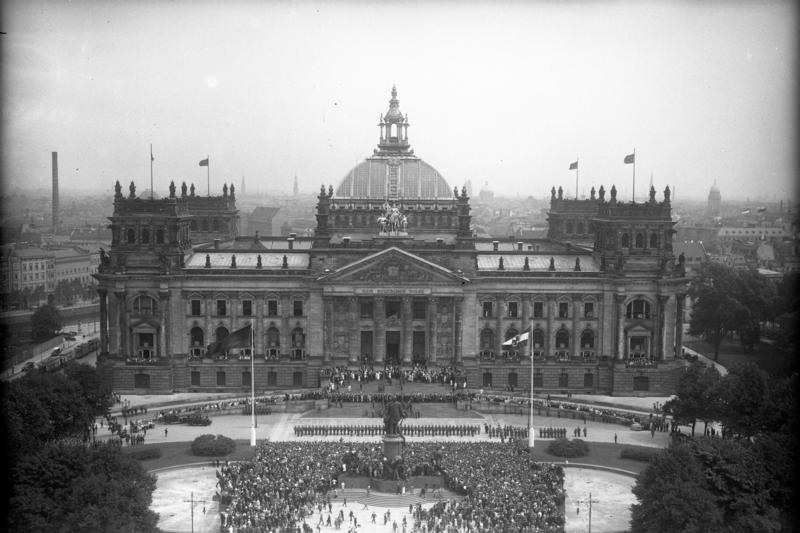 |
| Reichstag, August 1932, before fires |
The Reichstag was heavily damaged by arson in 1933 and later
by Russian shelling in the 1960s. The burning of the Reichstag in 1933 was
considered a symbol of Adolf Hitler’s rise to power, and he himself described
the fire as “a beacon from heaven. ‘You are now witnessing the beginning of a
great epoch in German history…This fire is the beginning’” ("Rise of Adolf Hitler" 1996).
Hitler never used the Reichstag as a place from which to conduct his revolution,
and it is in fact speculated that his own men conducted the arson so that he
may blame it on the Communists and gain further power. The physical symbol
remained, however, and even it its damaged state, the building likely had an
ominous presence in Berlin to those not in the Nazi party. For such an enormous
and seemingly indestructible building to be burned thus, it served as a
reminder of Hitler’s dominance over the republic that preceded him.
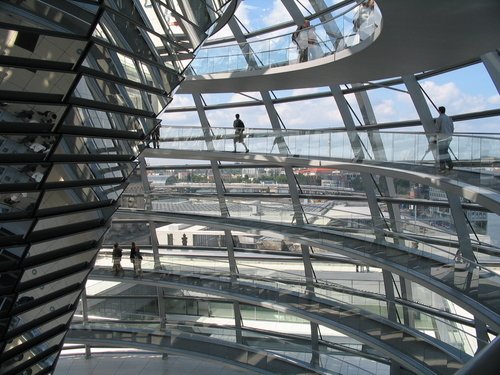 |
| Interior of Reichstag's glass dome |
In
1992, architect Sir Norman Foster won by competition the opportunity to
renovate the Reichstag, which had already been refurbished to an extant in the
1980s. It was a difficult task for Foster to not only renovate the building and
what it symbolized, but also to remain true to its history. "A lot of
events have passed over that building and left their imprint on the
fabric," says Sir Norman Foster. "I think it has more integrity to
reveal and accept the history, making it tangibly visible for present and
future generations." ("Reichstag: A turbulent history " 1999) Foster found the Reichstag’s surviving
nineteenth century interiors, complete with Soviet soldiers’ graffiti, already
hidden under plaster. Foster preserved these original walls and also reinstated
the original courtyards. The greatest change of all was the dome, in which
Foster traded the masonry for transparent glass. From within ramps running up
and along the inside of the dome, the public can look down at their government
officials at work and out at the city of Berlin. The clarity and openness of the
dome was a symbolic departure from the oppression of the Third Reich; in its
place, the glass dome becomes the new beacon of a brighter future. After the
renovation’s completion in 1999, the Reichstag had become a different building
and inspired a different set of emotions. Though the strength of the Reichstag’s
masonry, columns, and towers remains, the glass dome shines with hope, opportunity,
and change.
Sources:
The
History Place, "The Rise of Adolf Hitler." Last modified 1996. Accessed
August 31, 2012.
http://www.historyplace.com/worldwar2/riseofhitler/burns.htm.
"The Reichstag: A turbulent history ." BBC News. (1999). http://news.bbc.co.uk/2/hi/europe/322967.stm (accessed August 31, 2012).
