Showing posts with label Norman Foster. Show all posts

10/29/12

Architecture Advertises

By Shawna Hammon
Lecture - "Strategy & Identity"


Our buildings have become billboards!  When did this happen?  Using architecture as a billboard is not a new phenomenon, but why does it seem like all of our buildings are suddenly advertisements for the latest and greatest technologies or product lines?  I thought we designed buildings so that form follows function; we are not supposed to create forms and hope that we can fit our functions into it – looking at you Gehry.

Using architecture to demonstrate the power of a company is definitely not a new idea, take, for example, the Chrysler Building by William Van Alen in 1930 and later the AT&T Building by Philip Johnson in 1984, these buildings, even to this day, still function as they were meant to, but are blatant advertisements for the men or companies that funded them; somehow this idea seems more romantic when the building still serves it purpose.

Chrysler Building           AT&T Building              Hearst Tower

A more recent example of this trend is the Hearst Tower by Norman Foster in 2006, called the “most muscular symbol of corporate self-confidence” by The New York Times; it was the first skyscraper to reach completion in New York City since 9/11.  Joesph Urban designed the Art Deco style base, which was meant to be capped with a soaring tower; Foster realized this tower 70 years later with the new and old “colliding with ferocious energy.”

Another example of architecture as a flex of the corporate muscles is the Vitra Campus, a furniture factory campus in Switzerland; it is akin to an architectural playground.  It identifies itself as an “experiment in powerfully communicative architecture,” but what, exactly, is this architecture saying?  The website proclaims that “Vitra stands for an architectural concept that unites buildings by some of the most influential architects in the world.”  The Vitra are “collectors” of architectural objects by the likes of Frank Gehry, Zaha Hadid, Alvaro Siza and the list goes on.  Why are they collecting these objects?  Simple, all of these objects are part of the shrine of power that Vitra has created.  Some of the pieces in this collection, but most especially Hadid’s Fire Station, have been accused of lacking a function entirely because the spaces are impossible to use or do not adequately serve the program they were built for.  The Fire Station has since been transformed into additional gallery space, but Vitra commissioned this work by star architects not entirely for functionality, but more for the status symbol the work brings to the furniture factory.  Perhaps Vitra is also attempting to elevate the status of the factory worker, similar to the AEG Factory by Peter Behrens and the Fagus Shoe Last Factory by Walter Gropius, with buildings that do not scream “factory.”

Vitra Factory Campus

A final example of this deliberate use of architecture as a means to advertise a product or brand can be seen in designer brand flagship stores such as Prada and Louis Voutton.  It is disgusting how much money these companies can dump into these stores.  This flagrant use of building as an advertisement for the product and power of the company is likely expected by its clientele.

Although as a profession Architects do not advertise in the traditional sense via TV or radio ads, our buildings do advertise our wares or those of the clients we have designed for.  Frank Gehry, among others, is a prime example of this.  How laughable would it be to see advertisements, like those of lawyers, on TV for architecture firms “Let Gehry design your next iconic structure.  No fees charged until you are completely satisfied!”

Just because we can doesn't mean we should.


Sources:

10/1/12

Hit Home with the Biennale


By Francisco G. Zambrano
            
"Architecture is not only what it looks like, 
but also what it does." 
-Venice Biannale Poster

Fig.1: The entrance to the Architecture Biennale.
     
            Well where to even begin? For those of you who have not read the other blog posts, the Venice Biennale is an exposition that occurs ever two years with events that show case contemporary art exhibitions ranging from film, dance, art and architecture. The two most popular events are the film and architecture exhibitions. The theme for this years architecture exhibit was “common ground” and was lead by David Chipperfield. The reason for the theme was that David wanted to show how even though architects vary in origin, beliefs, styles and ideology, we, even students, share a common ground. This “common ground” means many things such as the earth, the common goal of an architect, methods of approach, design ideas etc.. Many of the exhibits managed to capture your attention and embrace you in their ideas and designs. Obviously some more than others, yet this is what they all tried to accomplish. Their “common ground” was to cause an effect to their surroundings and visitors.

Fig.2: Norman Foster exhibit at the Biennale.
            The first project to really absorb me and make an impact was the Norman Foster project. After walking through a narrow dark corridor, you turn into a dark room with sound of construction, destruction, accidents, people yelling, protests, all accompanied by large images projected onto the walls that would change at random time intervals. Apart from all of this, there were also moving words projected onto the floor. While being in this room, you are simply overwhelmed with all of imagery and noise that is going on around you. Then, after being in the space for a while and taking it all in, you start making sense of all of the chaos. The photographs, which were all taken by architects, photographers, writers and journalists from around the world, are of historic public spaces from the western world and major growing places in Asia and South America. With all of the chaos going on in the images, you get the idea that we, as well as the names of architects, designers, landscape architects, etc. that are being projected on the floor and yourself, are all responsible for what is going on. Likewise, this is our common ground, and we must all figure out a way to resolve this. I found this exhibit very fitting for the entrance to the exhibition, or as Norman Foster called it, a gateway.   

Fig.4: Objects from the pilgrimage..

Fig.3: Footage from the film
about the pilgrimage.
          One exhibit though that was not as immersive as others but that really hit the whole common ground message to me was that of the Pilgrim’s Route that is based in the mountain range in Jalisco, Mexico where I am from. My mothers’ family has attended this pilgrimage since my mother was four. She would tell me stories of how they would camp out under some tree, and if they were lucky enough, they would stay at a relative’s home and sleep on the floor. She told me about how they would walk through the rough mountain range for a whole week and when they reached the church, their feet would be so sore from so many blisters that they could not go up the stairs to the church entrance. She explained how they would cookout under trees and use the restroom out in the bushes. She would tell stories of some of the people whom they would meet on the way and their stories. These were stories that I could only perceive through my mother since I have never been. Yet now, I was seeing what they experienced on a projection a thousand miles away from where it happened. It blew my mind that I was in Venice, across the Atlantic Ocean, and here was a piece of home. Home being a place in the middle of no-where which no one had ever heard of, yet here in Venice, it was being displayed amongst projects from places of much higher recognition. It made me aware that it does not matter where you are or where you come from, some how we are all connected. Everyone’s problem is some how your problem, and believe it or not you can make a difference.
            
            The Biennale was a wonderful experience, one that I am grateful to have lived. Not only because of the really cool exhibitions, but because it really got through to me how we all have the responsibility of what happens to others on this world. We must think more of how our projects will not only affect the local area, but also how it will affect those who are not. We must go truly move from a local mentality to a world mentality, because we are now in the twenty-first century.
Fig.5: Clip from the pilgrimage video.
"Why are you here for Chuy?" 
-Pilgrimage Video


9/30/12

Great Experience at the Venice Biennale 2012


By Seth Oliver
"Great architecture is the design of space that contains, cuddles, exalts, or stimulates the perosns in that space." - Philip Johnson. I thoroughly enjoyed the 2012 Biennale in Venice! The theme was Common Ground and focused mainly on the architectural response to it. I felt as if it was set up just for our trip as architecture students to benefit from. I learned so much from this experience. It furthered my love for a few architects and spiked my interest in others. I will still have to say that the 2 exhibits I enjoyed the most were from Zaha Haddid and Norman Foster + Partners. Both are very different but inspire me to think outside of the normal realm.  Each of them deals with the idea of a movement in a space but the approaches are very different.


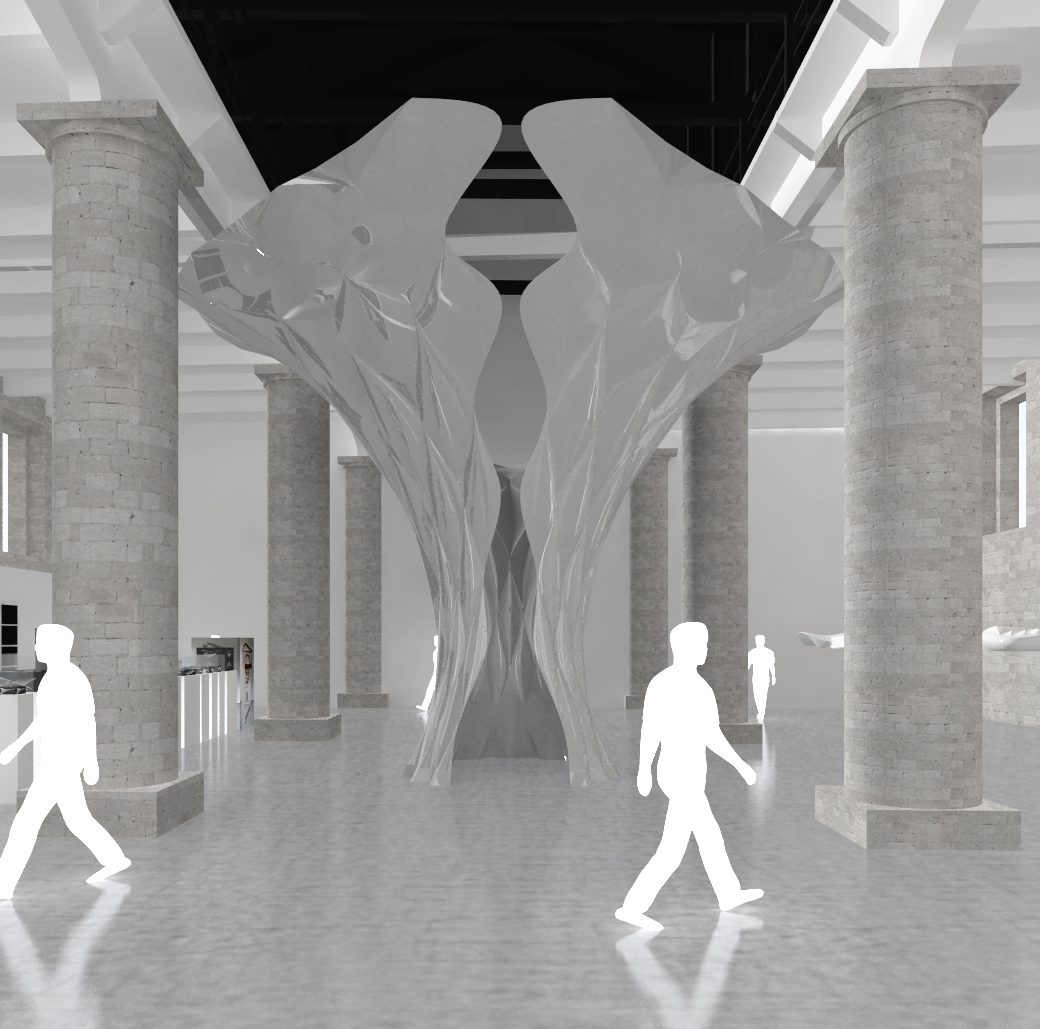
                The Hadid exhibition was all about the visual and the contrast of light and shadows. The main structure was a oversized platted metal piece. It looked similar to a lily before the petals have fully blossomed. There was an opening at the base, just large enough for a person to fit through and leading into a shaft with a small diameter that expanded as the metal grew taller. A single slit in the entrance separated the walls from coming full circle. The metal was cut and then bent in several different directions to fit this shape, but also to catch light at almost any angle. From the outside, the structure is elegant but commanding the attention of the room. Everyone is staring at it. However, inside the grand, silver petals, sound is close to being a loud silence. The inner circle fosters solitude and the feeling of being the only person in the room. I absolutely loved this piece of art. The power of a metal shield in a busy space is unreal. The level of detail is very precise and needs to be studied closely to really find the meticulousness of the work. It proves that no detail is too small to go unnoticed 


                The Norman Foster+ Partners exhibit was almost the opposite of the Hadid Exhibit. The space was dark except for the continuous moving projection of words in different directions on the floor and the constant quick slide shows and sounds. The Slide shows were all around the room and never had an image upon the wall for more than a few seconds. The images assaulted your eyes with the difference in colors from dark to bright at a quick pace. The content of the images varied. At one point there would be pictures of buildings and scenery with people laughing and getting along, and then there would be pictures of war, fire, crime and riots. The sounds were deafening and flipped from the fire of a guns to peaceful ocean waves and several others that came as quickly as they went. All of this put together made me feel as if I was meant to just stand and stare. Walking on the projected words was disorienting and there was nowhere else to go. The theme of common ground was extremely prevalent in this space. All people can experience joy and triumph, but also feel the hurt and pain of a struggle too.  I felt as if this was the first time I actually realized and comprehended that every other person in the world can feel exactly as I do. We are all human, but I just need reminding sometimes and this was the space that did it for me.


                I would definitely go back to this exhibition. I think there are a lot more things to observe and understand that I might have missed before. I know that my class was meant to see it as architecture students. We may have picked up on things that others did not, but it is in our hands to use the knowledge and experiences we gathered in Venice to apply it to our work in the future. 

9/29/12

Architectural Biennale: Finding Common Ground in a Diverse Field


By: Chris Melton

During our group's visit to Venice, we were able to attend the architecture Biennale, an event that is held for architecture every other year where different firms, architects, and countries come together to share ideas and work. We were fortunate enough to be able to visit both sections of the Biennale in one day; and my first impression of the convention as a whole was just how impressive of a variety of which different architects, firms, and countries chose to present their works. Exhibits ranged from large, inhabitable models, to fully crafted master plans, drawings, renderings, and everything else that lies in between. The only way to describe the sheer amount of information at this event was excessive. The most interesting aspect about this convention for me, was not just how different the presentation styles and projects between the two pavilions was, but how vastly varied each exhibit was inside of each pavilion. Both pavilions were fantastic in their own right, and singling out just a few presentations from each one does neither justice, so I would like to take some time to talk about what I found the most interesting at the first pavilion.

One of the best features of the first pavilion was the way in which it introduced the theme of the Biennale at the beginning of the exhibit. This set the bar for the rest of the presentations, most of which were crafted with this theme in mind. When you first walked in, the words "Common Ground," which of course was the theme, were boldly placed on the wall in front of you, and all around the room were posters (shown above) that further elaborated on the meaning of this theme. Upon reflection, one of the things that I found the most interesting was just how much in-progress work the architects chose to present in order to show process and narrative in the absence of an oral presentation. As I got to inspect everything from napkin sketches, to parti's, to different in-progress models (shown below), all of this process work showed something that the final model or project never could; how the architect thought and problem-solved to create the final project. This was a very interesting aspect for me, almost like a small glimpse into that firms' office, and it was probably why I enjoyed the first pavilion so much.


The second thing that I found the most interesting about this pavilion was the wide variety in how the architects showcased their work. Some presented very basic, clean models and master plans, while on the contrary some others compiled together with other firms and architects to create one master work. These works often came together using different methods and ideas that then created a model or master plan that was a hodgepodge of different ideas and styles that was actually quite interesting. I still feel strongly about how awesome of a feeling it was to walk from room to room and continually be just as interested in every new room. One of the presentations that excelled in this regard was the second room, the room that was directed by Norman Foster. From the instant you enter the room's threshold, the lack of lighting and music set the scene for a different experience for when you turn the corner. Shown below, Foster had thousands of words and pixels being projected across the walls, floors, and people as they walked about, as well as two video along the walls that presented his thoughts and ideas on the theme of Common Ground. This experience was entirely subjective, the more the viewer stayed and studied, the more they could understand and get out of it, but its boldness is why I enjoyed it so much. Overall, the Biennale was a fantastic sight to see, and I felt that its' theme for this year's convention was perfect. The fact that there are so many different ways to view, create, and present any architectural project is in fact the Common Ground that all architects stand on, and being able to explore this through the Biennale was definitely the best part of our Venice experience.

9/25/12

A Gateway to Common Ground: Norman Foster in Venice


By Jordan Grant

The 13th International Architecture Exhibition at the Biennale in Venice was a once in a lifetime experience, to say the least. I know many students, myself included, found it to be inspiring and amazing. Norman Foster was the curator for one of my personal favorite exhibitions. Located at the entrance of the Arsenal, he called the exhibit “Gateway”, which turned out to be more than appropriate.

My experience of the exhibit began even before I reached the threshold. As I neared the back of the first room, I began hearing sounds- big sounds, frightening sounds, sounds that make you want to walk in the opposite direction of whatever could possibly be making them. Then I turned the corner, only to find a very narrow hallway ending only in black, while the noises got louder and louder. As I ventured down the hallway I found yet another corner to turn, and such is how I came to see the exhibit for the first time. A dark room, filled with lights and pictures all moving across the floors and walls, camouflaged the people already standing in the exhibit as if they had become part of it- and in this way I also became part of it.

First I stuck out my hand and watched the words crawl across it, almost like holding a caterpillar of light. The multitude of words made it almost impossible to read them individually and they constantly intersected and overlapped in a geometric manner, almost like someone had held a dictionary upside down and shook it until all the words fell out.

I was in the midst of observing this sea of words when my focus was ripped away and turned towards the film on the wall- or rather, I should say films, as 10 screens played concurrently, each flashing their own series of images and projecting their own noises. The viewer is really left with no option but to stand in the center of the room and turn in circles in an attempt to understand the connection between the screen and their subjects. People and places from all over the globe appeared in glimpses, some longer than others and sometimes the screens all faded except one with a lone figure or empty space. But eventually the lights and sounds become overpowering and then the viewer is forced to find the exit, which is only a small curtain completely obscured from view.

Though I knew I did not understand the exhibit entirely, I knew that it was serving as a threshold to the rest of the Biennale and was therefore extremely important. How it manipulated my senses and emotions was genius, so I decided to do a little more research about it. The title of this year’s Biennale (given by Curator David Chipperfield) was “Common Ground”, and Norman Foster stuck with this given theme in his exhibit. The words crawling across the floor are actually the names of people in history that have shaped the physical environment, including but not exclusively names of architects. The words are projected straight to the floor, giving a literal meaning to “Common Ground”- the ground is now a collection of past and present figures all sharing a common interest and profession in the built environment. Foster has created unity in this way.

Next, the walls- showing pictures of meeting places across the world, western world next to eastern, first world side by side with third world, peace next to war, rich next to poor. It’s a reminder that we all share the same spaces, no matter where you are. Foster’s exhibit is a tool to prepare visitors for the rest of the Biennale with the realization that the world in which we live is shared, and that it is indeed “Common Ground”. Bravo, Mr. Foster- bravo.


9/24/12

A Postcard: The Venice Biennale


By Shawna Hammon
A Postcard - The Venice Biennale

The Biennale was by far my favorite experience in Italy thus far, so where do I begin?  I had the luxury of going to the Biennale two days.  On the first day I went to the Giardini and to Arsenale on the second.  Even with two full days to see it all, I did not get to everything, so I’m quite excited that we are going back just before it closes in November.  In the meantime, I have to tell you about the three exhibits that struck me the most – The Piranesi Variations by Peter Eisenman, Gateway by Norman Foster, and Eduardo Souto de Moura’s structure along the waterfront of the Arsenale.  

 
Eisenmen assembled a team of students and practitioners to “revisit, examine and reimagine Giovanni Battista Piranesi’s 1762 folio collection of etchings, Campo Marzio dell’antica Roma (Rosenfield).”  This exhibit consisted of 4 teams – Yale University School of Architecture, Ohio State University Knowlton School of Architecture, Eisenman Architects, and Dogma.  My two favorites were A Field of Diagrams by Eisenman Architects and A Field of Dreams by Ohio State because they were both visually appealing, but they also had some great diagrams on the wall that told even more about how they reimagined Rome.  The whimsical quality of the Field of Dreams was delightful, and I felt like every time I moved around the model I saw more and more – it was so animated.


Norman Foster’s Gateway exhibit was by far the most inventive in terms of its use of technology.  He teamed up with film director Carlos Carcas and artist Charles Sandison to bring us this immersion in multimedia collage – you enter the black box and are immediately inundated with sounds and films on the wall.  Names of artists, architects, designers from all walks of life are on the floor and swirl around you if you aren’t too shy to step into it. I would never have thought that architecture would find a place I this sort of media, but I think it was more than appropriate to make us consider its message – social change.


Finally, Eduardo Souto de Moura’s structure along the Arsenale waterfront has left a distinct mark in my mind.  Probably due, in part, to the insight and enthusiasm on Professor Lucca’s part – he was really quite struck by it.  According to Souto de Moura “geography becomes how we want it to be. This it the great leap of the modern movement, and as a result of postmodernism (Basulto).”  The installation “reflects the evolving relationship between interior and exterior, the gradual opening up of options, and their dependence and influence on the architectural language (Baulto).”  The juxtaposition between his form and the old building across the river is just… inspiring – I’m not sure I can even put words to it.

Likely my descriptions have done these exhibits no justice; you’ll just have to see it for yourself.   I hope you are as excited to see them as I am to see them again. 


Sources:

Basulto , David . "Venice Biennale 2012: Eduardo Souto de Moura" 06 Sep 2012. ArchDaily. Accessed 30 Sep 2012. <http://www.archdaily.com/267891>

Rosenfield , Karissa . "Venice Biennale 2012: The Piranesi Variations / Peter Eisenman" 31 Aug 2012. ArchDaily. Accessed 30 Sep 2012. <http://www.archdaily.com/268507>